
Quest MMORPG Guide: How to Pick a Game With Great Quests
A quest MMORPG lives or dies by its questing - a well-written task can keep you hooked for hours, while a lazy fetch errand makes you close the client in minutes. Here's a breakdown of quest types, the games that do questing best, and what to look for before you commit to a new MMORPG.
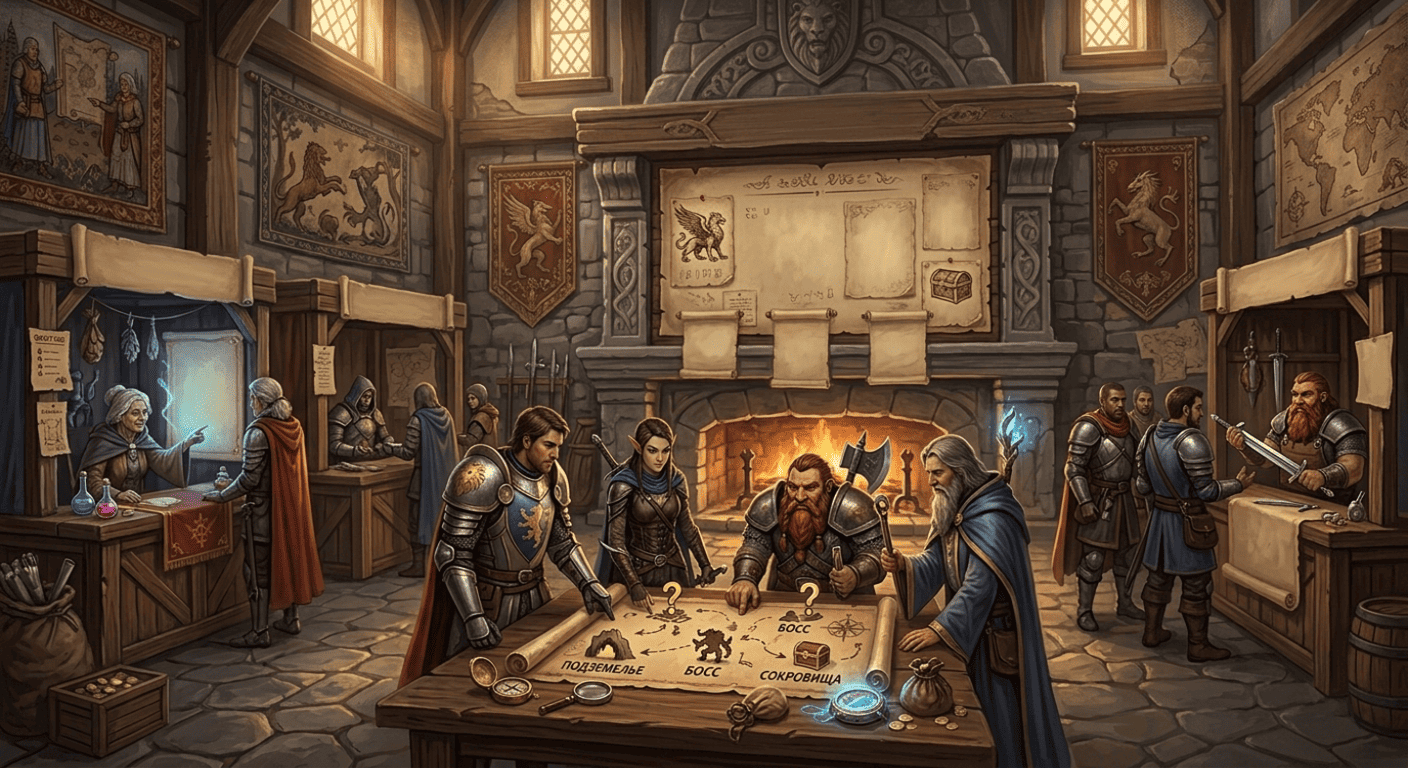
Where Quests Came From and How They Reached MMORPGs
Quests didn't start in MMORPGs - they trace back to text-based computer games of the 1970s.
The text-based origins
Between 1975 and 1976, programmer William Crowther, a caving enthusiast, wrote Colossal Cave Adventure - the first work of interactive fiction and the ancestor of every quest-based game since. Players read a room description and typed commands like "go north" or "take lamp" to work toward a goal.
Crowther's friend Don Woods, a Tolkien fan, later expanded the game with elves, trolls, and a volcano, turning a realistic cave-exploration sim into a fantasy adventure. That combination - a goal, an obstacle, and a reward - became the template for what we now call a quest.
In 1979, a group of MIT students impressed by Adventure founded Infocom, whose first release was the text quest Zork I. The word "quest" itself entered gaming vocabulary a bit later, borrowed by Sierra On-Line for titles like King's Quest and Space Quest.
From solo adventures to shared worlds
While text adventures grew into the standalone adventure-game genre, multiplayer online worlds were developing separately. Ultima Online launched in 1997 as the first fully realized persistent virtual world, followed two years later by EverQuest - a game players joked you could actually die in, thanks to brutal grinding and death penalties.
Quests in these early MMORPGs were closer to a loose pile of NPC errands than a connected story. EverQuest still pushed the genre forward with a huge volume of quests and dungeons plus early item-trading market mechanics, but delivery stayed minimal and text-heavy.
The World of Warcraft quest revolution
The real turning point came in 2004. Blizzard's World of Warcraft team spent nearly a year playing EverQuest to study what worked, and lead designer Rob Pardo wanted to keep that sense of community while giving players the clear sense of purpose EverQuest's near-endless grind lacked.
The result was a quest system that felt local, understandable, and rewarding on every step - a sharp break from the aimless grinding of earlier MMOs. Industry writers still split MMORPG history into "before WoW" and "after WoW," calling it the first MMO people actually lived in rather than just played. Quests as the primary tool for content delivery and player onboarding became the genre standard, and that approach underpins every game in the comparison table below.
Further evolution
After WoW, studios kept experimenting with the format:
- Guild Wars 2 (2012) dropped static quests for dynamic events that trigger without any player interaction.
- The Elder Scrolls Online (2014) brought full voice acting and branching dialogue, borrowing techniques from single-player RPGs.
- Final Fantasy XIV pushed cinematic storytelling to a level rivaling story-driven JRPGs.
Thirty-plus years of development - from typed commands in Crowther's cave to fully voiced story arcs - turned the quest from a simple errand into one of the genre's core retention tools.
What Quests Actually Do in a Quest MMORPG
A quest is a structured task with a goal, a reward, and - ideally - a story reason to care. In a quest MMORPG, quests serve several jobs at once:
- Guide players through the world in a sensible order instead of dumping the whole map on day one.
- Reveal lore - faction history, character backstories, ongoing conflicts.
- Provide a predictable source of experience, gear, and currency.
- Connect players to each other through group and guild-level tasks.
Early World of Warcraft's Stormwind quest chain is a textbook example: it walked new players through the city district by district long before they could see the full world map, a pacing trick still used by quest designers today.
Quest Types: From Fetch Errands to Full Story Arcs
Most quest MMORPGs mix several formats so the game doesn't turn into pure repetition.
Basic formats
- Collect and deliver - bring an NPC a set number of items. Simple, but tedious if overused.
- Kill quests - clear a set number of enemies for experience or a specific drop.
- Escort missions - protect an NPC while it moves through dangerous territory.
- Exploration quests - find a location, activate a point of interest, or reveal part of the map.
Advanced formats
- Story chains - a linked series of quests with dialogue choices that affect reputation.
- Dynamic events - quests with no fixed starting point that trigger automatically when players enter a zone, the hallmark of Guild Wars 2.
- Group raid quests - multi-stage tasks only available to a team of 5–20 players.
- Branching-outcome quests - the result depends on player choices, as in The Elder Scrolls Online.
15 Best MMORPGs for Questing
Here's a side-by-side comparison of the games most consistently praised for quest design.
| Game | Quest System Type | Voice Acting & Dialogue | Impact on Story | Beginner Difficulty |
|---|---|---|---|---|
| Final Fantasy XIV | Linear story campaign | Full voice acting for key scenes | High, single unified story | Medium |
| The Elder Scrolls Online | Branching dialogue | Full voice acting | High, choices affect endings | Low |
| Guild Wars 2 | Dynamic events + personal story | Partial voice acting | Medium | Low |
| World of Warcraft | Mixed: linear chains and world quests | Partial voice acting | Medium | Medium |
| Black Desert Online | Grind-heavy plus story lines | Text dialogue | Low | High |
| Star Wars: The Old Republic | Full dialogue quests with faction choices | Full voice acting | High, companions react to choices | Low |
| Lost Ark | Linear campaign + island-specific stories | Partial voice acting | Medium | Medium |
| New World | Territory-based quest chains | Text dialogue | Low | Medium |
| RuneScape (Old School) | Hundreds of standalone quests, each with unique mechanics | Text dialogue | Medium, quests drive progression | High |
| EVE Online | Agent missions plus corporation story arcs | Text dialogue | Low, the world matters more than plot | High |
| Lineage II | Classic grind and reputation chains | Text dialogue | Low | High |
| Neverwinter | Instanced story campaigns based on D&D lore | Partial voice acting | Medium | Low |
| Albion Online | Tutorial quests for an open sandbox | Text dialogue | Low | Medium |
| TERA | Fast-paced, combat-focused quests | Partial voice acting | Medium | Low |
| Blade & Soul | Combat arc with boss fights and cutscenes | Partial voice acting | Medium | Medium |
Each of these games fits a different priority: pick Final Fantasy XIV or Star Wars: The Old Republic for cinematic storytelling, Guild Wars 2 or New World for open-world freedom, and Old School RuneScape if you want dozens of standalone puzzle-style quests.
What Separates a Good Quest From a Filler Task
Not every task with a reward attached counts as good design. Experienced players judge quests by a few consistent markers.
- Clear objective - no need to check a wiki to figure out what to do.
- Reasonable reward - the item or experience matches the effort required.
- Context - the quest explains why the character is doing this, rather than issuing a task with no reason attached.
- Some mechanical variety - at least part of the questline breaks from standard kill-and-fetch.
- No artificial padding - no forced running across the whole map without a good reason.
A hypothetical example: a quest that asks you to collect 10 wolf pelts is still a fetch task, but pairing it with a short scene of a hunter explaining he needs the pelts for the village's winter clothing gives the same grind actual context - and that context is usually what makes it feel less tedious.
Tips for Finding a Quest MMORPG You'll Actually Enjoy
- Watch gameplay footage of the first 10–15 levels before buying - that's where pacing and quest quality show up fastest.
- Check whether dialogue is voiced; it shapes how the story lands far more than most players expect.
- Scan reviews for complaints about "quest grind" - repeated mentions usually point to weak quest design.
- Try a free trial if one's available; your gut reaction to the opening quests matters more than any review score.
- Match the format to your taste: linear MMORPGs suit story lovers, sandbox MMORPGs suit players who want freedom.
FAQ
Which quest MMORPG has the best questing in 2026? There's no single winner: Final Fantasy XIV is most often praised for its cinematic storytelling, while The Elder Scrolls Online stands out for dialogue variety and choices that actually change quest outcomes.
What's the difference between a story quest and a regular quest? A story quest belongs to a game's main narrative chain and usually includes voice acting and cutscenes, while a regular quest is typically local, self-contained, and doesn't affect the broader plot.
Can you skip quests in an MMORPG without losing progress? Technically yes, if the game lets you level through dungeons or PvP instead, but you'll miss out on a chunk of content and lore along the way.
Why do quests in some MMORPGs feel repetitive? It's usually a content-budget issue - developers lean on template mechanics like "collect and kill" to fill the world with tasks faster than writing unique quests for every zone.
Should quest quality be the deciding factor when choosing an MMORPG? Quests matter, but they're not the only factor - combat systems, economy, and community activity matter just as much, especially if you're planning to stick with the game long term.