
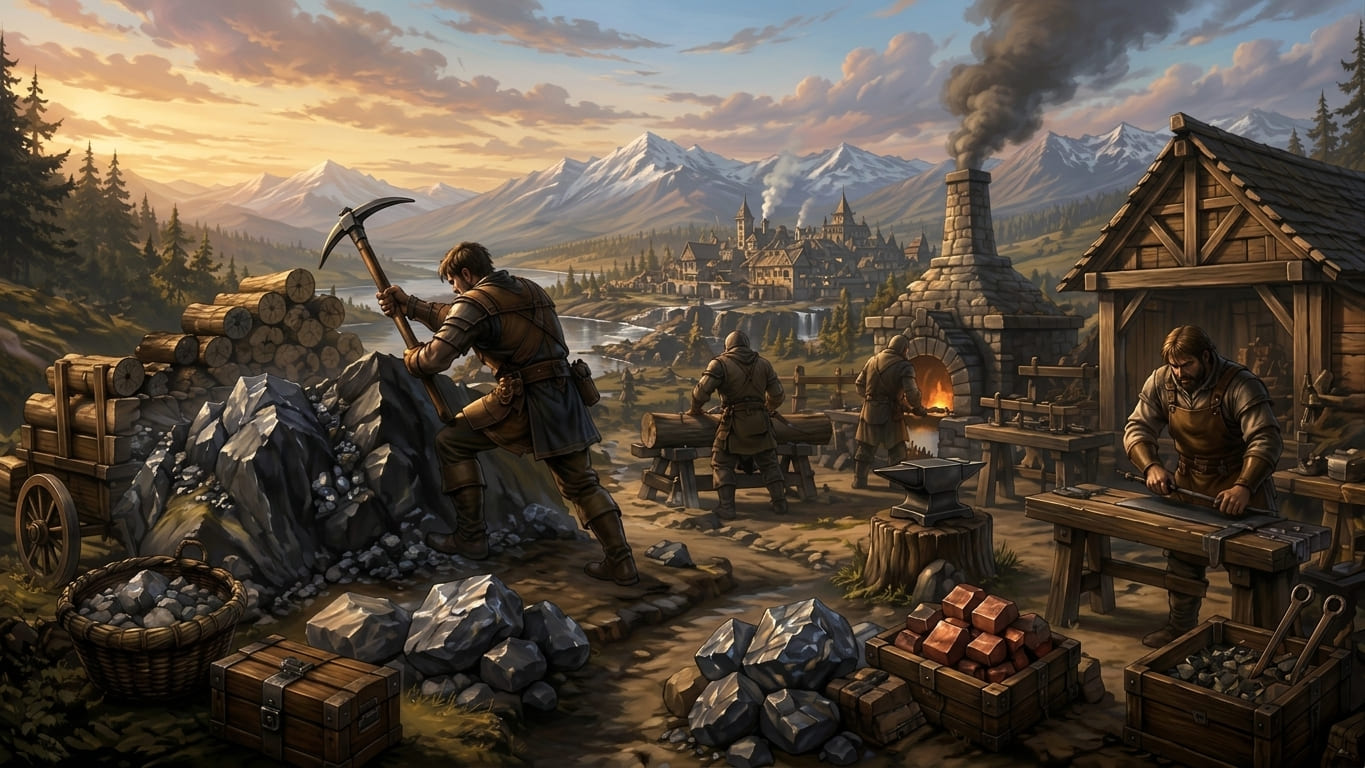
A resource gathering game revolves around collecting materials, processing them, and using them for building, crafting, or survival. The genre spans survival titles, strategy games, and simulators - from Minecraft to Enshrouded, and the choice is wider than it first appears.
What Sets a Resource Gathering Game Apart
At the core of the gameplay is a collection loop: find a resource, gather it, spend it on structures, weapons, or upgrades. Progress depends on the quantity and quality of stockpiled materials, not just combat skill.
A typical example: a player chops wood, gets planks, builds shelter, then mines stone for next-tier tools. Each step unlocks new crafting recipes.
The difference from pure action games is pacing. What matters here isn't reaction speed but planning - how much wood a house needs, how much ore a pickaxe requires, what to prioritize with limited inventory space.
Core Genre Mechanics
Most titles share a similar set of systems, though each puts a different spin on them.
- Raw material collection - chopping, mining, gathering herbs, hunting animals for hides and meat.
- Limited inventory - weight or slot caps force players to plan their trips.
- Crafting trees - recipe chains where simple materials turn into complex items.
- Processing - furnaces, workbenches, and machines that turn ore into ingots and logs into planks.
- Resource depletion - nodes either respawn over time or require players to seek new gathering spots.
Some titles add an economic layer: gathered materials can be sold to other players or NPCs, turning farming into a source of in-game currency - this is how Rust and No Man's Sky handle it.
15 Best Resource Gathering Games
Below is a full lineup of titles most often recommended for their crafting depth and resource-gathering balance.
| Game | Platforms | Genre Focus | Price |
|---|---|---|---|
| Minecraft | PC, consoles, mobile | Sandbox, building | ~$25 |
| ARK: Survival Ascended | PC, consoles | Survival, dinosaurs | ~$30 |
| Valheim | PC | Norse survival | ~$20 |
| Terraria | PC, consoles, mobile | 2D adventure | ~$10 |
| Satisfactory | PC | Industrial building | ~$30 |
| Grounded | PC, consoles | Backyard survival | ~$20 |
| Raft | PC | Ocean raft survival | ~$20 |
| Palworld | PC, consoles | Creature survival | ~$30 |
| Rust | PC | Hardcore survival, PvP | ~$40 |
| 7 Days to Die | PC, consoles | Zombie apocalypse survival | ~$25 |
| Subnautica | PC, consoles | Underwater survival | ~$25 |
| No Man's Sky | PC, consoles | Space exploration | ~$40 |
| Green Hell | PC, consoles | Jungle survival | ~$20 |
| Enshrouded | PC | Fantasy survival, crafting | ~$30 |
| Icarus | PC | Expedition survival | ~$25 |
Each title tackles resource gathering differently, and that difference matters when picking one.
Minecraft remains the genre's benchmark: block-based gathering with no real time pressure, ideal for creative farming without stress.
ARK: Survival Ascended and Grounded raise the stakes with creature threats - you either tame them or avoid them, which forces route planning ahead of time.
Valheim and Raft center on travel: rare materials sit in new biomes or drifting wreckage, not right next to your base.
Satisfactory turns gathering into an engineering problem - conveyor belts and factories automate what other games make you do by hand.
Rust and 7 Days to Die add real risk: gathered materials can be lost to a raid or a zombie horde, so building defenses runs parallel to farming.
Subnautica moves gathering underwater - the deeper the location, the more valuable and dangerous the resources.
No Man's Sky scales the loop up to space: materials fuel crafting and starship fuel alike.
Green Hell and Icarus lean into realism - exhaustion and injury directly affect how efficiently you can gather.
Palworld and Enshrouded are newer entries that blend farming with creature taming or timed co-op expeditions.
Terraria stays the compact option for players who want deep crafting without a 3D world or steep hardware requirements.
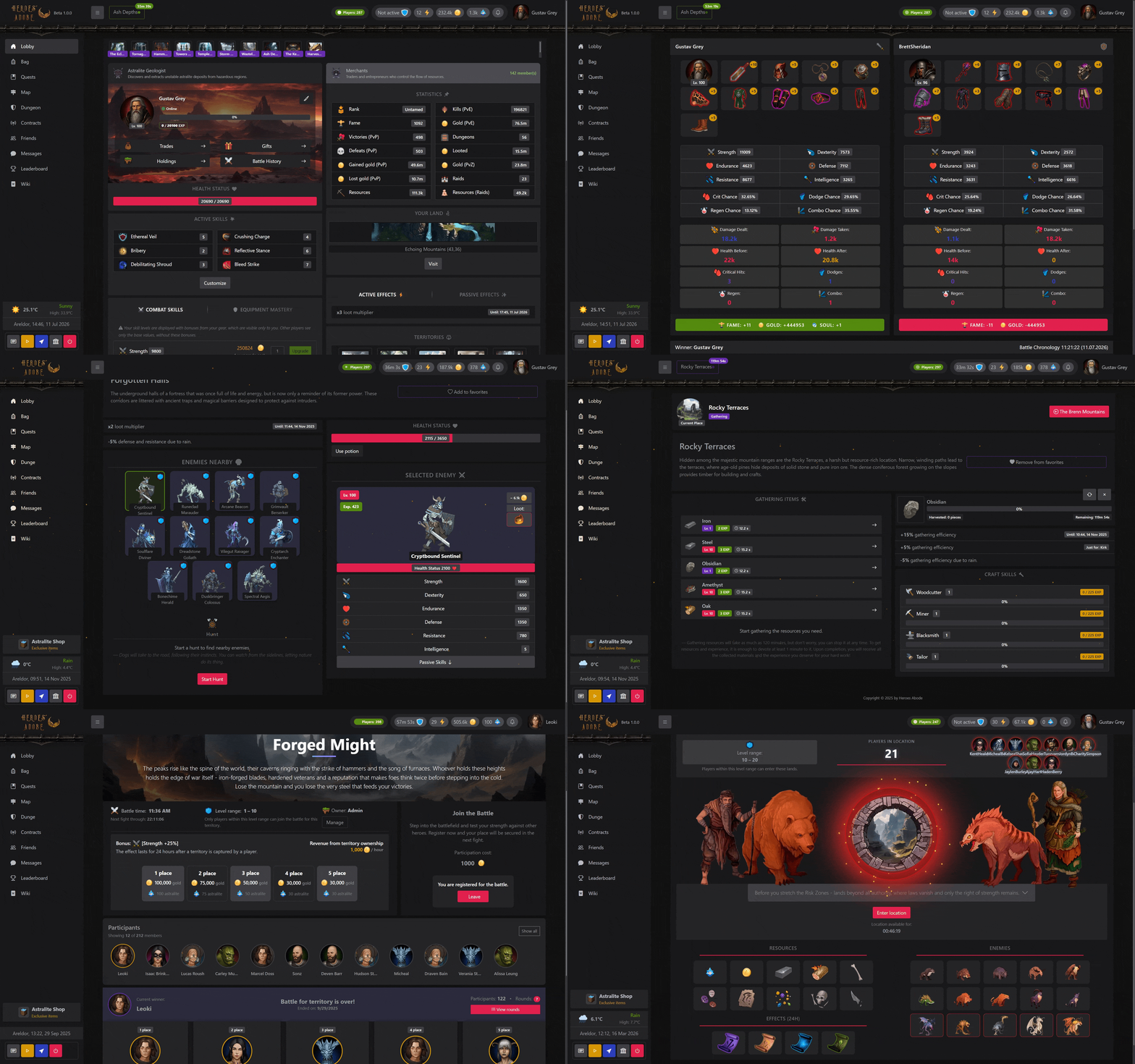
Dive into the Legendary World of Heroes Adobe!
Are you looking for a truly deep text-based MMORPG where every decision, character progression, and live interaction matters?
Immerse yourself in Heroes Adobe - an exciting browser-based role-playing game crafted for fans of classic adventures and a well-crafted fantasy world. An engaging journey full of unexpected twists and tactical possibilities awaits you.
 |
|
Become part of this captivating story right now. Head over to Heroes Adobe, create your hero, and start your journey to glory!
How to Choose the Right Game for You
The right pick depends on what matters most - solo play, co-op, or a competitive edge.
- For relaxed building, go with Minecraft or Terraria - low barrier to entry, flexible pacing.
- For deep automation, pick Satisfactory - gathering evolves into full factory design.
- For co-op with friends, Valheim, Raft, and Enshrouded work well - shared farming and base defense.
- For risk and PvP, Rust makes losing gathered resources as likely as collecting them.
- For world exploration, No Man's Sky and Subnautica tie gathering closely to discovering new territory.
Platform also matters: some titles, like Satisfactory, Rust, and Enshrouded, are PC-only, while Minecraft, ARK, and Palworld support cross-play.
Tips for Efficient Resource Gathering
Experienced players rely on a handful of tricks that speed up progress regardless of the specific title.
- Plan your gathering route ahead of time - it saves you from backtracking between spots.
- Upgrade your tools as early as possible: a better axe or pickaxe sharply increases gathering speed.
- Build your base near multiple resource types at once - forest, water, ore.
- Don't spend rare materials on early recipes if cheaper alternatives are nearby.
- Use sorted chests or storage to avoid wasting time hunting for an item in your inventory.
This approach works just as well in Minecraft as in more complex titles like Satisfactory or Icarus, where logistics mistakes are especially costly.
FAQ
Which resource gathering game is best for beginners?
Minecraft and Terraria are the most accessible options. Simple crafting mechanics and an intuitive gathering system make them easy to pick up within the first half hour.
Can you play resource gathering games for free?
None of the top titles listed are fully free, but studios regularly run giveaways on Steam or the Epic Games Store, and several offer free demos.
How does gathering differ between survival games and building sandboxes?
In survival titles like Rust or Green Hell, gathering is tightly linked to threats - hunger, enemies, weather. In sandboxes like Minecraft, farming mostly serves creative goals without system-driven pressure.
Do resource gathering games require an internet connection?
No, most titles, including Minecraft, Valheim, Terraria, and Subnautica, offer a full offline single-player mode.
Which game works best for co-op play?
Valheim, Raft, and Enshrouded are built around playing together: splitting roles between gathering, building, and base defense works especially well in a group of 2–4 players.